How High-Channel Count Radar Eliminates Ambiguities
– Radar ambiguities occur when one physical object appears as multiple targets scattered across the field of view, making it impossible to distinguish actual road hazards from background objects like guardrails, tunnel walls, or parked cars, causing fundamental safety failures in autonomous driving systems
– Ambiguities stem from the Nyquist sampling theorem: conventional radars with sparse channels (typically 12 transmit x 16 receive) cannot determine signal direction. Arbe’s 48 transmit x 48 receive configuration creates 2,304 virtual channels that provide dense spatial sampling to eliminate ambiguities at their source
– Arbe’s custom chipset architecture processes 30 gigabytes of raw RF data per second, compressing it into a 100-megabyte point cloud output, enabling thousands of virtual channels and tens of thousands of detections per frame without latency that would compromise safety-critical applications
– While AI-based filtering, cameras, and LiDAR offer alternative approaches, only high-channel count radar directly solves the fundamental Nyquist sampling problem while maintaining all-weather reliability and long-range detection capabilities required for autonomous driving
– Arbe’s dual innovation—dramatically increasing antenna channel density while engineering processing architecture to handle massive data volumes—eliminates the fundamental sampling limitations that create ambiguities, delivering the reliable perception foundation needed for Level 3 autonomy
How High-Channel Count Radar Eliminates Ambiguities
– Radar ambiguities occur when one physical object appears as multiple targets scattered across the field of view, making it impossible to distinguish actual road hazards from background objects like guardrails, tunnel walls, or parked cars, causing fundamental safety failures in autonomous driving systems
– Ambiguities stem from the Nyquist sampling theorem: conventional radars with sparse channels (typically 12 transmit x 16 receive) cannot determine signal direction. Arbe’s 48 transmit x 48 receive configuration creates 2,304 virtual channels that provide dense spatial sampling to eliminate ambiguities at their source
– Arbe’s custom chipset architecture processes 30 gigabytes of raw RF data per second, compressing it into a 100-megabyte point cloud output, enabling thousands of virtual channels and tens of thousands of detections per frame without latency that would compromise safety-critical applications
– While AI-based filtering, cameras, and LiDAR offer alternative approaches, only high-channel count radar directly solves the fundamental Nyquist sampling problem while maintaining all-weather reliability and long-range detection capabilities required for autonomous driving
– Arbe’s dual innovation—dramatically increasing antenna channel density while engineering processing architecture to handle massive data volumes—eliminates the fundamental sampling limitations that create ambiguities, delivering the reliable perception foundation needed for Level 3 autonomy
When radar sees one object but reports multiple identical targets, how do you know which one is real? This radar ambiguity problem has plagued autonomous driving systems, but the solution lies in dense sampling that eliminates phantom signals at their source.
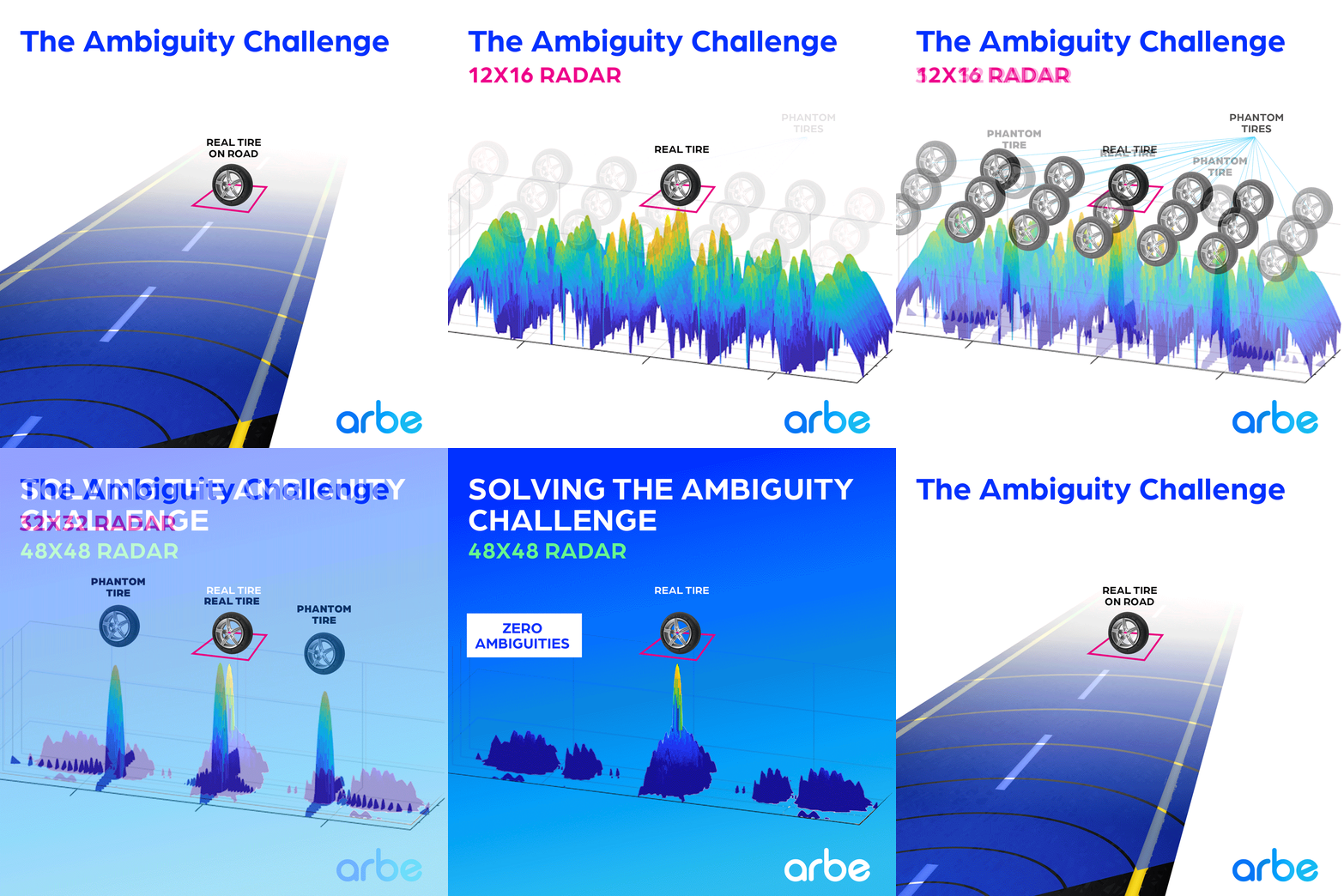
Radar ambiguities occur when a sensor views one physical object but reports multiple targets with similar power levels scattered across its field of view. Picture placing a single object in front of a radar. Instead of seeing one clean target, the system might display multiple identical false targets in addition to weaker phantoms. The radar literally cannot tell which target is real.
This breakdown in sensor reliability creates two distinct types of problems. Doppler ambiguities affect velocity measurements of moving targets, but can be resolved by taking multiple measurements (though this adds 100-150 milliseconds of latency). Azimuth and elevation ambiguities, on the other hand, affect angular direction and are unmanageable for autonomous driving.
When you can’t trust whether the radar shows a real obstacle or phantom, the fundamental safety premise collapses. Azimuth and elevation ambiguities create phantom targets for all objects, but the safety failures manifest differently:
For stationary objects, the core problem is distinguishing relevant obstacles from irrelevant background:
For moving objects, phantom targets create a different computational challenge: one real vehicle appears as multiple identical targets scattered across different locations. The system must track all these phantom trajectories simultaneously while using complex algorithms to determine which path is physically possible – adding dangerous latency and consuming significant processing power.
Radar ambiguities stem from a fundamental principle: the Nyquist sampling theorem. Just as a camera filming a spinning propeller at too low a frame rate can make it appear to rotate backward, radars with sparsely placed antenna channels cannot definitively determine the direction of incoming signals.
Denser sampling solves the problem but requires enormous processing power and energy consumption – challenges that traditional automotive-grade systems struggle to meet cost-effectively. It’s a classic engineering trade-off between having many antenna channels (good performance, high cost) versus fewer channels (affordable, but ambiguous).
Understanding the radar sampling limitations that cause ambiguities, the automotive industry has considered various approaches, but none offers a “silver bullet.” Traditional solutions have focused on working around the ambiguity problem through AI-based filtering, alternative sensor technologies like cameras and lidar, or simply accepting limited functionality with basic automotive radars designed primarily for moving targets.
Through two critical innovations, Arbe directly solves the fundamental Nyquist sampling problem: we achieve the denser sampling needed to eliminate ambiguities by dramatically increasing antenna channel density and designing the processor architecture required to handle the resulting massive data volumes.
Arbe’s high definition radar technology uses 48 transmitting and 48 receiving channels – far exceeding traditional radar configurations – to provide the dense spatial sampling needed to definitively determine signal direction of arrival. This high-channel count directly eliminates the ambiguities that plague sparse antenna arrays, but creates an enormous processing challenge: 30 gigabytes of raw RF data per second that would overwhelm conventional radar processors. Our custom chipset architecture addresses this by compressing the data into a 100-megabyte point cloud output, enabling thousands of virtual channels and tens of thousands of detections per frame without the latency that would compromise safety-critical applications.
| Solution Approach | Advantages | Disadvantages |
| Traditional Automotive Radars | Good for basic safety features and moving target detection | Fewer antenna channels create highly ambiguous patterns; insufficient for detecting stationary objects |
| AI-Based Ambiguity Resolution | Could potentially learn to distinguish real from phantom targets | Unproven for safety-critical applications |
| Camera-Only Systems | High-resolution visual data at lower cost | Vulnerable to weather and lighting conditions |
| Lidar Solutions | Precise 3D mapping | Vulnerable to weather conditions, have limited range and higher costs compared to radar |
| Arbe’s HD Radar | Eliminates ambiguities through dense sampling; reliable in all weather; long-range detection | Requires purpose-built processing and advanced chipset architecture |
The road to Level 3 autonomy runs directly through solving ambiguity challenges. Arbe’s dual innovation, significantly increasing antenna channel density while engineering the processing architecture to handle massive data volumes, directly eliminates the fundamental sampling limitations that create ambiguities, delivering the reliable perception foundation that hands-free driving requires.
Connect to learn more