The Interference Threat: Thousands of vehicle and roadside radars sharing the narrow 76–81 GHz band create signal collisions that cause false braking, ghost objects, or missed hazards.
Legacy FMCW Vulnerability: Traditional radars transmit predictable frequency sweeps, making mutual interference inevitable as radar density increases on Level 3 autonomous roads.
Patented Multi-Band Randomization: Arbe breaks spectrum into smaller frequency segments transmitted in statistically unique patterns, preventing continuous overlap with nearby radars.
Layered Defense Architecture: A 3-tier protection stack combines signal avoidance, chirp-to-chirp frequency dithering, and statistical filtering to preserve total data fidelity.
Built for Scalable Autonomy: Integrated directly into Arbe’s core chipset, this interference mitigation stack ensures reliable imaging radar perception across dense future traffic.
The Interference Threat: Thousands of vehicle and roadside radars sharing the narrow 76–81 GHz band create signal collisions that cause false braking, ghost objects, or missed hazards.
Legacy FMCW Vulnerability: Traditional radars transmit predictable frequency sweeps, making mutual interference inevitable as radar density increases on Level 3 autonomous roads.
Patented Multi-Band Randomization: Arbe breaks spectrum into smaller frequency segments transmitted in statistically unique patterns, preventing continuous overlap with nearby radars.
Layered Defense Architecture: A 3-tier protection stack combines signal avoidance, chirp-to-chirp frequency dithering, and statistical filtering to preserve total data fidelity.
Built for Scalable Autonomy: Integrated directly into Arbe’s core chipset, this interference mitigation stack ensures reliable imaging radar perception across dense future traffic.
The future highway will not contain a handful of radar systems. It will contain thousands.
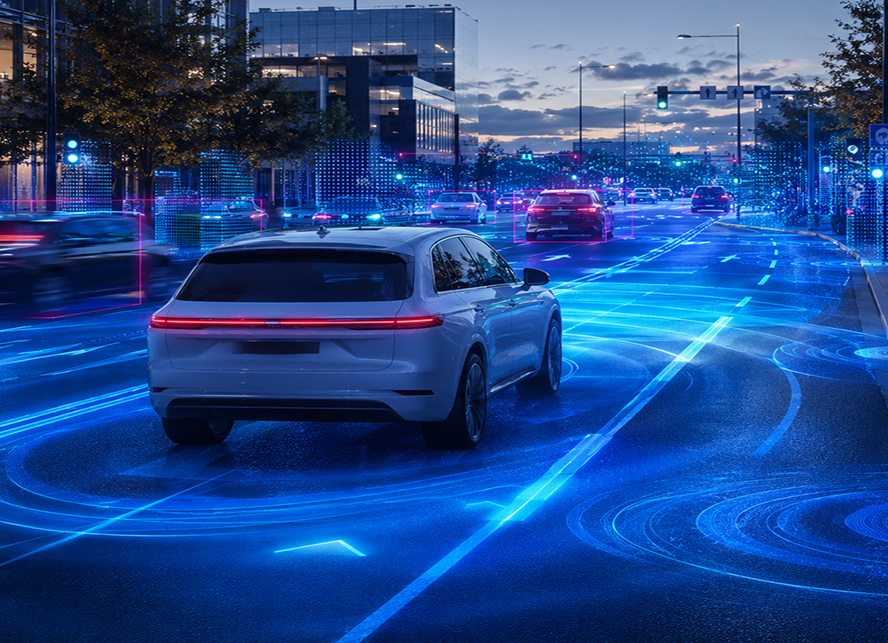
Every autonomous vehicle, smart traffic system, and roadside sensor will be continuously transmitting and receiving radar signals at the same time. Modern premium vehicles already carry more than 6 radars supporting functions like adaptive cruise control, blind spot monitoring, emergency braking, and highway autonomy. As Level 3 autonomy scales, that number will only grow.
For the automotive industry, this creates a problem that is becoming increasingly difficult to ignore: radar mutual interference.
Radar systems work by transmitting signals and analyzing the reflections that return from the environment. But in radar-dense environments, sensors do not only process their own reflections. They are also exposed to signals transmitted by radar systems operating nearby.
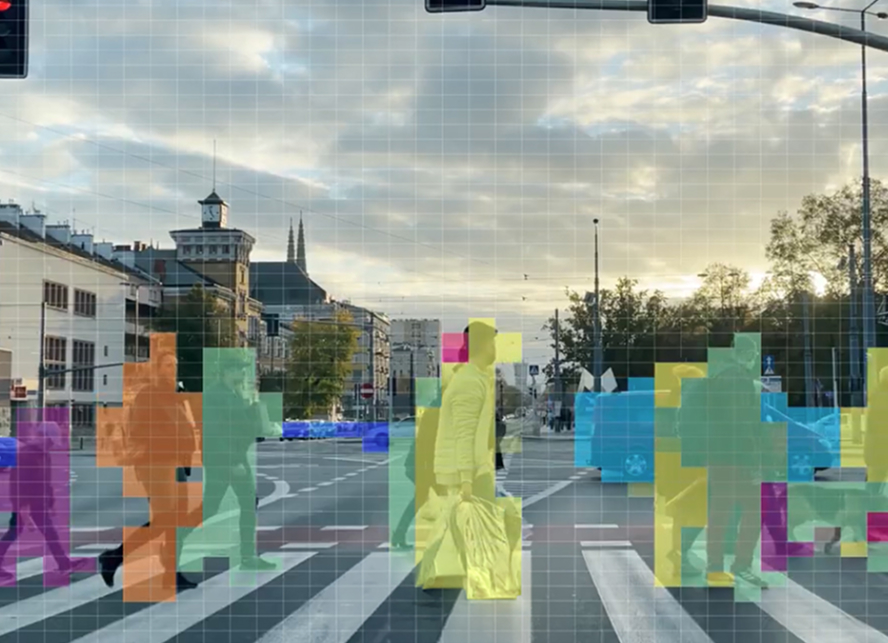
These outside signals can create ghost objects, distort velocity measurements, reduce sensitivity, or obscure real hazards entirely. In practice, this can lead to false emergency braking events, phantom obstacles, or missed detections of critical objects such as pedestrians and vehicles.
For today’s driver assistance systems, that may lead to reduced performance. For Level 3 autonomous driving systems, where the vehicle becomes responsible for driving under certain conditions, the stakes are much higher.
Radar mutual interference is not the result of flawed radar design. It is the natural consequence of more radar systems competing for the same finite spectrum. The issue is compounded by how most automotive radars are designed to operate today.
Most radar systems rely on conventional FMCW transmission schemes that repeatedly sweep through frequencies in highly predictable sequential patterns. That approach worked when relatively few radar systems shared the road.
But as radar density increases, predictable transmission patterns begin colliding more frequently. It becomes harder for a radar to distinguish its own reflections from the signals generated by nearby vehicles and infrastructure.
The challenge is made even more difficult by spectrum constraints. Automotive radars worldwide are required to operate within the 76–81 GHz band. Long-range automotive radars are typically confined to an even narrower 76–77 GHz portion of that spectrum. In other words, the applications that depend most on interference robustness, such as high-speed driving, long-range detection, and dense highway traffic, also have the least spectrum available to work with.
It is similar to entering a crowded room where everyone speaks in the same voice, at the same volume, at the same time. Eventually, individual conversations become impossible to separate.
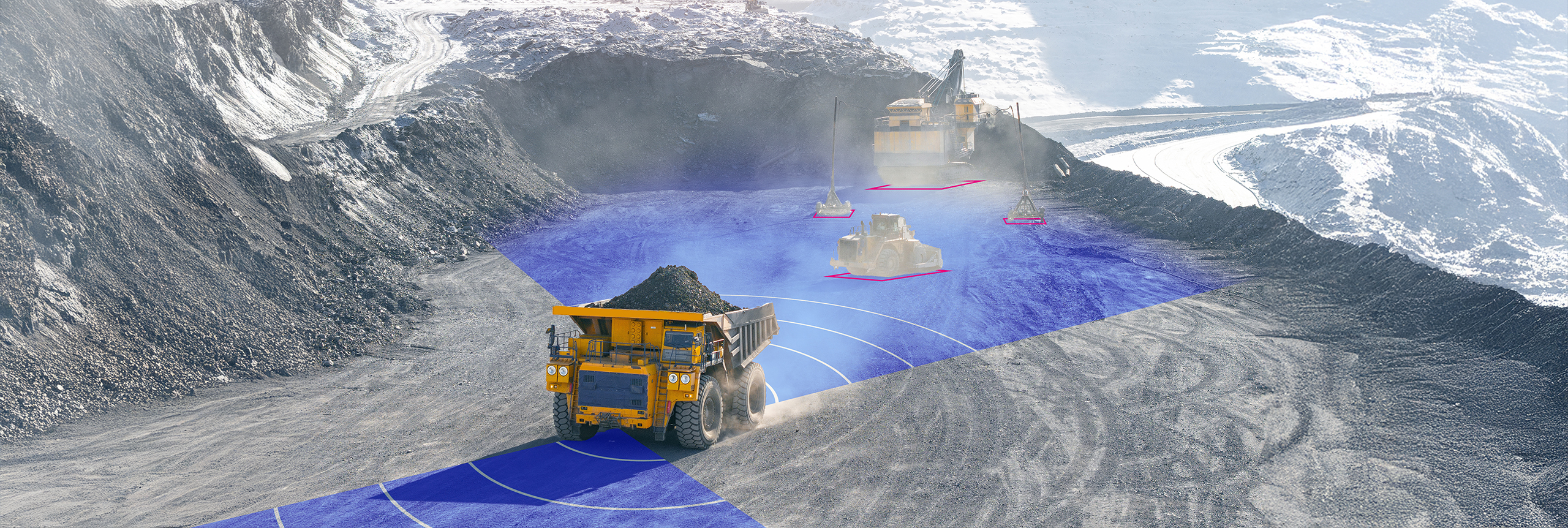
This challenge becomes even more severe in dense urban environments, where autonomous vehicles, traffic infrastructure, and connected transportation systems may all be operating simultaneously within the same spectrum.
As the automotive industry moves toward Level 3 autonomy, solving mutual interference is becoming a foundational requirement for reliable perception.
Because mutual interference cannot be eliminated, the challenge shifts from avoiding interference to building radar systems that remain reliable despite it.
Instead of transmitting radar chirps sequentially across the frequency band, Arbe’s radar architecture breaks the available spectrum into many smaller frequency segments and transmits them in randomized patterns. This patented FMCW approach dramatically reduces the likelihood that neighboring radar systems will continuously overlap with one another.
Rather than every radar repeatedly broadcasting the same predictable signal structure, each transmission becomes statistically unique. The chances of neighboring radars interfering with one another in a consistent way drop dramatically.
This approach is powerful, but it is also technically difficult. Once the radar breaks the signal into randomized frequency segments, the system has to reassemble those pieces correctly in processing while preserving accurate range resolution. That is why Arbe’s architecture relies on a dedicated processor designed to handle this kind of signal complexity.
The goal, of course, is not to pretend interference will never happen. In a future filled with radar-equipped vehicles, some level of interference is inevitable. The challenge is building radar systems that can continue operating safely when it does.
That resilience comes from combining multiple layers of protection.
The first layer focuses on avoidance. Randomized multi-band chirps and center-frequency hopping reduce the likelihood that neighboring radar systems remain aligned on the same frequencies over time, helping prevent radar-on-radar interference before it occurs.
The second layer focuses on mitigation. If interference is detected, the system identifies corrupted chirps and removes them from processing. Arbe also employs dithering, which introduces small chirp-to-chirp frequency variations to suppress fixed-frequency interference that can affect Doppler and velocity measurements, rather than the radar-on-radar collisions that frequency hopping targets. Phase-per-chirp techniques provide additional ways to distinguish intended signals from unwanted signals.
Together, these techniques address multiple forms of interference challenges rather than relying on a single solution.
The final layer focuses on filtering. Statistical detection algorithms analyze incoming radar data to identify and suppress remaining interference patterns while preserving the larger picture of the surrounding environment.
Importantly, this interference mitigation stack is not tied to a specific channel count. It is part of Arbe’s core radar architecture across Arbe-based configurations. Higher channel counts, such as 48 transmit and 48 receive channels, contribute to higher resolution, richer radar images, and more detailed detection, while the interference mitigation architecture remains consistent across configurations.
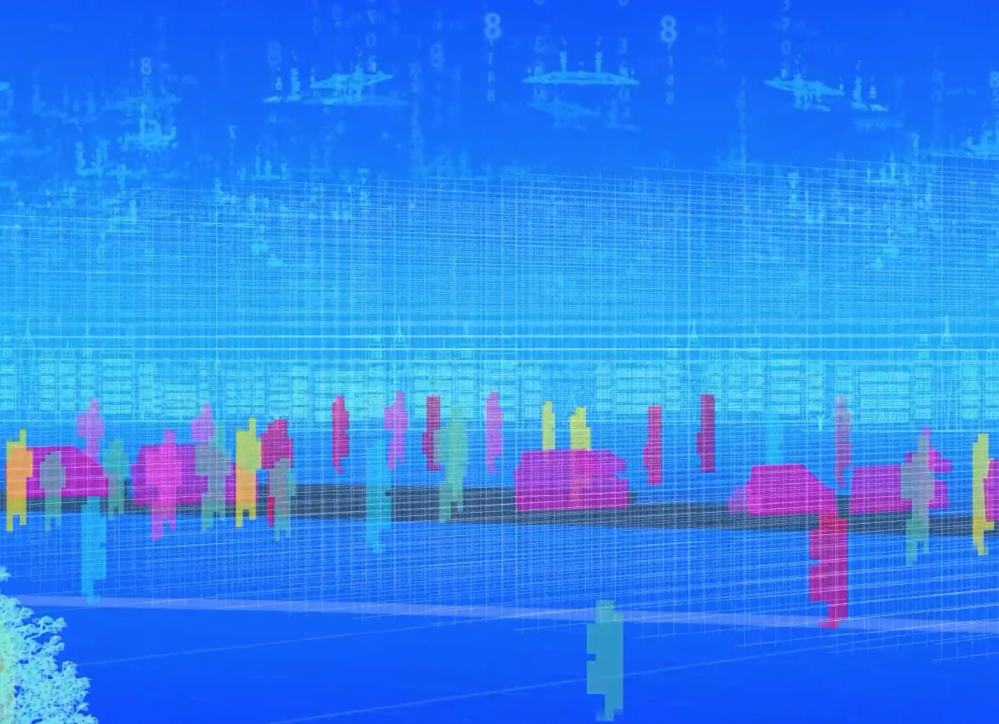
Resilience also comes from how imaging radar works over time. Arbe’s radar creates many environmental frames per second. If interference affects part of one frame, the next frames help fill in the picture. Together, architectural mitigation, rich radar imaging, and continuous environmental updates help the system maintain a reliable view of the road even in radar-dense environments.
The system is built for redundancy and resilience rather than assuming the road will always be free of interference.
Radar is becoming a foundational perception technology for Level 3 autonomous driving and the next generation of vehicle safety systems. As autonomous driving systems scale, radar-dense roads will become unavoidable.
As a result, radar architectures designed to avoid, mitigate, and filter interference are becoming increasingly important. As radar-equipped vehicles multiply, the capability of maintaining a clear and reliable view of the road in crowded spectrum environments is crucial for making Level 3 autonomy practical at scale.