Arbe’s Final RF Chipset: The New Gold Standard for Radar
Arbe’s Final RF Chipset: The New Gold Standard for Radar
Arbe is constantly pushing the envelope to provide our customers with perception radar that surpasses any other radar solution on the market by leaps and bounds. The latest in our continuous efforts to ensure the highest possible levels of safety is the launch of our final RF chipset production configuration. The new RF Chipset provides increased range and reduced power consumption, while offering design flexibility combined with ultra high radar native resolution – an industry first. The result is enhanced optimal performance across customer verticals and driving scenarios.
Arbe’s proprietary RF chipset includes a transmitter chip with 24 channels and a receiver chip with 12 channels. We have achieved state-of-the-art RF performance at the lowest cost per channel on the market. Coupled with Arbe’s cutting-edge radar processor, this RF chipset provides up to 48×48 channels – or up to 2304 virtual MIMO elements – which is twelve to twenty times more compared to the best-in-class radars available today at retail costs. This is the key in Arbe’s technology ability to achieve native high-dynamic range in all dimensions, avoiding angular ambiguity, minimizing false alarms, especially for complex use-cases and challenging environments. All of the combined advantages add up to the best radar image quality on the market, effortlessly detecting objects in complicated use cases such as a vehicle under a bridge, a tire on the road, a pedestrian near a guardrail, a motorcyclist over 250 meters away, and more.
The new Transmitter chip introduces features that achieve significant advantages. It provides a best-in-class output power of 12.5 dBm from a single channel, which allows long range detection of over 300m for a vehicle with a single channel, while also reducing the power consumption per chip by 50%. The transmitter also supports beamforming, simultaneous transmission from multiple channels, which can increase vulnerable road user (VRU) detection range to 350m, and vehicle detection to 800m.
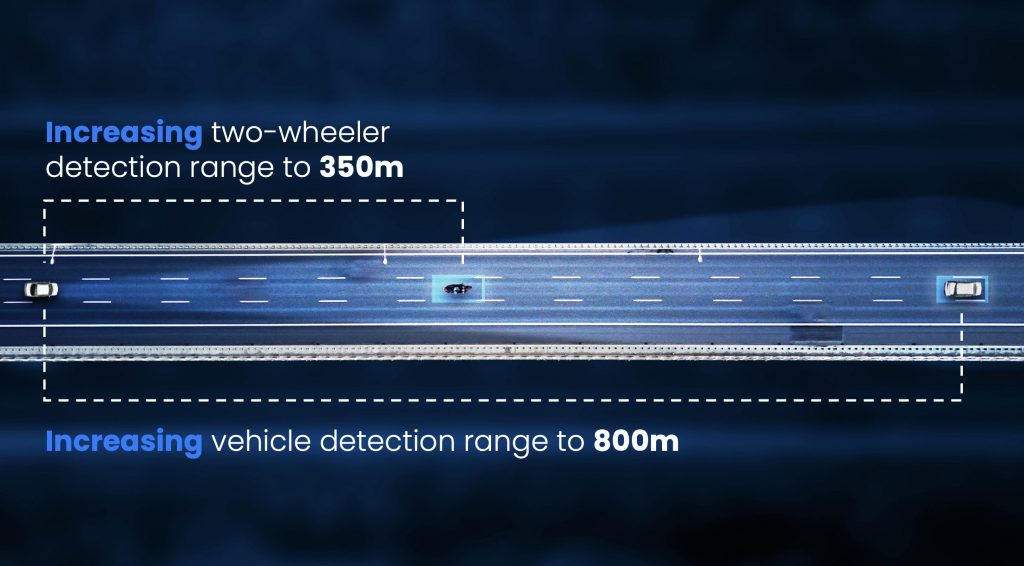
This ability to transmit from multiple channels provides the much needed flexibility in radar design and wave form (modulation) design to optimize performance across customer verticals and driving use cases.
Further, Arbe’s beamforming has a minimal impact on resolution, dynamic range & spatial ambiguity. While current 12×16 Radars can provide Tx beamforming capabilities, the low number of channels means that transmitting from several together comes at the expense of the MIMO array size, reducing resolution and increasing sidelobes. Arbe’s significantly larger number 48*48 MIMO channels affords much more flexibility in design as compared to 12*16 arrays, resulting in minor impact on the resolution.
The new receiver chip, likewise offers important improvements. We have successfully released on-chip temperature auto-calibration to fully support the automotive temperature requirements, enabling the chip to work with the same calibration over the entire range, from -40 to 150 degrees Celsius. As with the transmitter, the power consumption per chip has been reduced by 50%, outperforming all other solutions in power consumption per channel. The noise figure has been reduced to 11 dB, which is the best noise figure in the industry. This means that the system has high sensitivity, which in turn contributes to enhanced range and the ability to detect small objects. Finally, the receiver is ASIL-B, AEC-Q100, Automotive Grade 2, and Automotive Grade 1 ready.
Arbe’s final RF Chipset production configuration achieves long range sensing and high sensitivity, while reducing power consumption significantly and maintaining performance stability across the entire automotive temperature range. Its high physical resolution imaging allows the system to track moving objects, map the environment and stationary obstacles, generate free-space mapping for easy path planning, and provide accurate localization.
Beamforming is important for addressing many challenging use cases, such as spotting a flat tire on the highway, enabling delivery robots to drive safely on the sidewalk, and developing forward and backward free space mapping, particularly for unprotected left turns, T junctions, merging onto the highway, and more.
These advancements contribute to the delivery of the best radar image quality on the market, and to the achievement of unmatched levels of safety in a wide range of driving scenarios via ultra-long range and beamforming.
Connect to learn more